Category : Test, Measurement & Instrumentation
Analog Discovery Studio (ADS)
The ADS is designed primarily for education and lab environments, offering the same core functions as AD2/AD3 but in a larger, classroom-friendly form factor with convenient built-in connectors and power supplies.
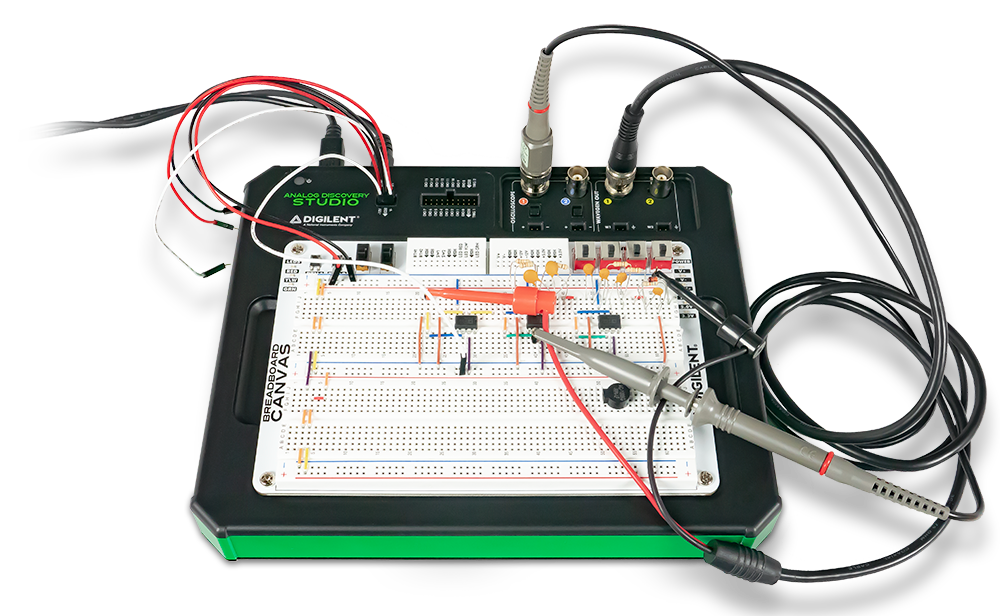
Analog Discovery Studio (ADS) Technical Specification
| Type | Portable Mixed-Signal All-in-One Instrument |
| Software | WaveForms (Windows, macOS, Linux) |
| Analog Inputs | 2 channels, 14-bit, 100 MS/s, ±25 V |
| Analog Outputs | 2 channels, 14-bit, 100 MS/s, ±5 V |
| Digital I/O | 16 channels, up to 100 MS/s |
| Logic Compatibility | LVCMOS (1.8 V / 3.3 V), 5 V tolerant inputs |
| Integrated Instruments | Oscilloscope, Waveform Generator, Logic Analyzer, Pattern Generator, Power Supplies, DMM |
| Power Supplies | ±12 V, +5 V, +3.3 V |
| Prototyping Area | Removable "Canvas" with breadboard and I/O headers |
| Connectivity | USB 3.0 |
| API Support | Python, C/C++, LabVIEW, MATLAB |
| Bandwidth (Analog In) | ~30 MHz |
Applications
- • Electrical and electronics engineering labs
- • Analog and digital circuit experiments
- • Courseware integration and hardware training setups
Overview
The Analog Discovery Studio (ADS) is a fully functional, portable test and measurement device that can turn any cross-functional space into a pop-up electronics laboratory. Equipped with 13 instruments, including an Oscilloscope, Logic Analyzer, Spectrum Analyzer, Waveform Generator, and more; the Analog Discovery Studio replaces an entire lab of individual instruments with a convenient interface and brings instrumentation to every students desk. Removable and replaceable Canvases enable sharing of a single device among many students in the same lab – a student can take their canvas home to build and prototype their circuits before the day of the lab. A breadboard canvas is included with every ADS while others are sold separately. Different canvases offer different learning opportunities – offerings include those with substantial breadboardable space, through-hole and surface-mount solderable surfaces for prototyping, various digital components, and even the ability to mount an FPGA development board for mixed-signal – analog and digital – coursework.